With this World Cup expanding to 48 teams across 12 groups, the qualification rules are noticeably more complex than before — it’s no longer as simple as “the top two in each group advance.” The bracket even features cryptic-looking labels like “A/B/C/D/F 3.” I found a clear wallchart online, so let me break down the qualification rules to help you understand who your team might face next.
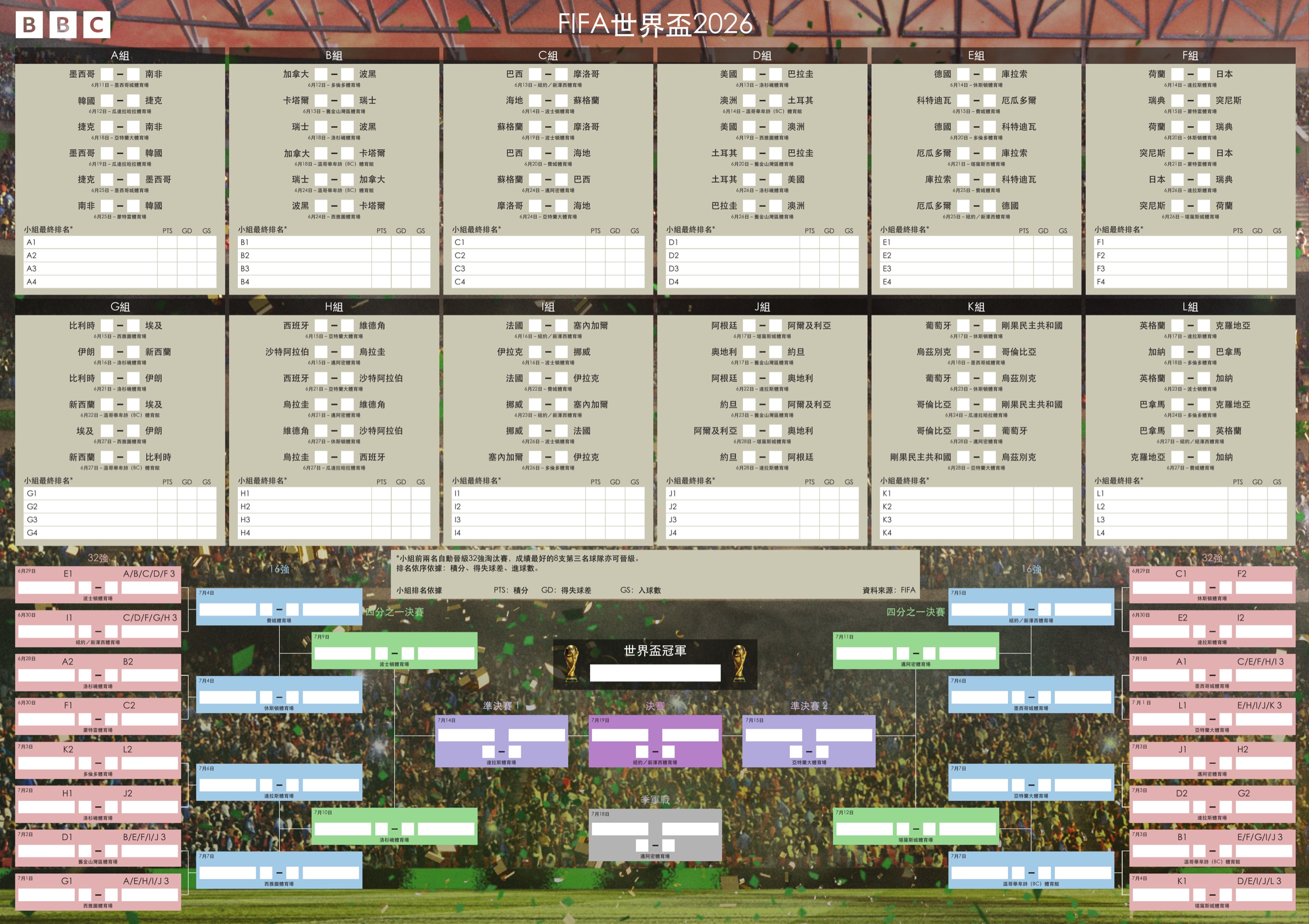
The Threshold: Top Two Are Safe, 8 More Tickets Up for Grabs
In each of the 12 groups, the top two automatically advance to the Round of 32 knockout stage — no ambiguity there, accounting for 24 spots. The remaining 8 spots go to the best-performing 8 of the 12 third-placed teams, who join the advancing field.
In other words, even if your team only finishes third in its group this time around, there’s no need to despair — they’re not out yet. It comes down to how the third-placed teams in the other 11 groups performed, and how your team’s record compares. Personally I love this design: it gives third-placed teams extra incentive to compete and to keep attacking, rather than giving up on matches easily.
How the Ranking Works: Points, Goal Difference, Goals Scored
To sort which of the 12 third-placed teams make up the “best 8,” three metrics are checked in order:
- Points (PTS)
- Goal Difference (GD)
- Goals Scored (GS)
If points are level, goal difference breaks the tie; if that’s also level, goals scored decides it. The logic is the same as in-group ranking, except this time it’s used to compare third-placed teams across different groups.
Key Point: The Bracket Has Already Baked In “Who Could Play Whom”
This is the most interesting — and most easily confusing — part.
Since you can’t know which 8 teams will advance as third-placed sides until all group matches are done, the bracket can’t hard-code a fixed matchup like “Group A third vs Group B third” — because Group A’s third might not advance at all. FIFA’s solution: lay out the 16 Round-of-32 fixture positions in advance, where 8 of those positions are matchups between two already-determined teams (e.g., a group winner vs a group runner-up), while the other 8 positions are reserved for the “best third-placed teams” — with each such position pre-restricted so it can only be filled by a third-placed team from certain specified groups.
The actual matchup ranges work out as follows:
| Group Winner / Runner-up | Opponent restricted to third-placed team from these groups |
|---|---|
| Group E Winner | Third from A, B, C, D, F |
| Group I Winner | Third from C, D, F, G, H |
| Group D Winner | Third from B, E, F, I, J |
| Group G Winner | Third from A, E, H, I, J |
| Group A Winner | Third from C, E, F, H, I |
| Group L Winner | Third from E, H, I, J, K |
| Group B Winner | Third from E, F, G, I, J |
| Group K Winner | Third from D, E, I, J, L |
Why Can Each Slot Only Be Filled by a Third-Placed Team from “Certain Groups”?
This is where the seeding/zoning rules come in.
Ultimately 8 of the 12 third-placed teams will advance, but exactly “which 8 groups” they come from is unknown until all group matches finish — and the number of possible combinations alone runs into the hundreds. FIFA’s solution is to prepare a complete allocation table in advance (the zoning rules): for every possible combination of “which 8 groups’ third-placed teams advance,” it specifies in advance which fixture position each of those 8 teams should fill.
This table is designed around two core principles:
- Avoid same-group rematches: as far as possible, teams that already met in the group stage shouldn’t immediately face each other again in the Round of 32.
- Maintain bracket balance: spread the advancing third-placed teams evenly across different sections of the bracket, rather than clustering them all on one side.
It’s precisely because both conditions must be satisfied simultaneously that each slot reserved for a third-placed team is pre-restricted to being filled only by third-placed teams from certain specified groups. A label like “A/B/C/D/F 3” on the bracket is simply the candidate range that this allocation table has defined for that slot — exactly which group ends up filling it can only be settled once all 8 third-place spots are confirmed and cross-referenced against the allocation table.
The remaining 8 Round-of-32 fixtures are standard matchups where both sides’ identities are already determined — for example, a group winner vs a group runner-up, or two group runners-up against each other — and are unaffected by the list of third-placed teams.
What Does This Mean for the Final Round of Group Play?
Once you understand these rules, the final round of group matches becomes far more interesting to watch — especially for teams that have already secured advancement but are still swinging between first and second place in their group. After all, finishing first isn’t necessarily the best outcome: if the opponent waiting for the runner-up is actually weaker than the “best third-placed candidate” the group winner would face, then deliberately playing it safe and settling for second to advance isn’t an impossible strategy. That’s also why the odds in the final round of group play are often harder to read than you’d expect.